Wankhede Stadium Mumbai - IPL 2026 venue guide
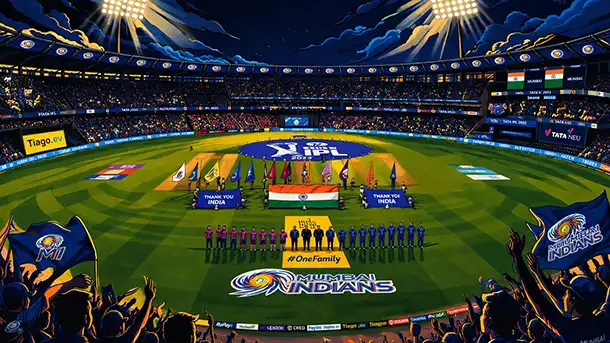
Wankhede Stadium Mumbai will host seven confirmed Mumbai Indians (MI) home matches during IPL 2026, making it one of the busiest venues in the league stage. The schedule includes fixtures on 29 Mar, 12 Apr, 16 Apr, 23 Apr, 29 Apr, 04 May and 24 May, covering almost the entire season from early phase to late stage. This gives the ground a full workload compared to split venues like Bengaluru. With an average first innings score around 170 and recent trends pushing totals higher, Wankhede remains a high-scoring but more balanced venue than Chinnaswamy. Its role in IPL 2026 is central, with multiple key clashes involving MI, CSK, RCB and KKR.
Unlike smaller high-scoring venues, Wankhede combines batting-friendly conditions with early assistance for seamers. The red-soil surface offers bounce and carry, especially in the first overs. However, once the ball softens, stroke play becomes easier and scoring accelerates quickly. This creates a two-phase game dynamic rather than a constant run flow.
Stadium overview and key facts
The structural profile of Wankhede Stadium directly explains how matches develop here. From pitch composition to boundary size, each factor influences scoring patterns and team strategy.
| Parameter | Details | Notes / IPL relevance |
|---|---|---|
| Full name | Wankhede Stadium | Also Mumbai Stadium |
| Location | Mumbai, Maharashtra | Sea-level venue with humidity impact |
| Capacity | ~33,000 | Compact but intense atmosphere |
| Established | 1974 | Renovated for 2011 World Cup |
| Home team | MI | Strong home record |
| Pitch type | Red soil, good bounce | Supports pace early, batting later |
| Boundary size | ~62-75 m | Balanced, not extremely short |
| Floodlights | Yes | Dew affects night matches |
The combination of bounce and fast outfield makes Wankhede a scoring venue, but not a flat batting track from ball one. Bowlers get a short window early in the innings before conditions shift towards batters. This creates more tactical depth compared to smaller grounds. Teams that use the new ball well often control the game.
History and significance in Indian cricket
Wankhede Stadium has been Mumbai’s primary international venue since 1974 and has hosted major moments in Indian cricket. It staged the 2011 World Cup final and numerous high-profile Tests and IPL matches. The ground is closely associated with Mumbai’s cricket culture and legacy players. Its central location near Churchgate makes it one of the most accessible stadiums in India.
In IPL terms, Wankhede is strongly linked with MI and their success over multiple seasons. The venue has seen dominant home performances as well as high-scoring defeats. It is not a one-sided ground, which makes it more unpredictable than purely batting-friendly venues. Over time, it has built a reputation for balanced but high-tempo cricket.
“At Wankhede, the first six overs often decide the entire match.”
This reflects how critical the powerplay phase is at this ground. Early wickets or early runs can shift momentum more sharply here than at slower venues. Teams that misread this phase often struggle to recover.
Pitch report – Wankhede Stadium
The Wankhede pitch is known for true bounce and early seam movement, especially under lights. Fast bowlers can generate swing in the first few overs due to coastal conditions. As the innings progresses, the surface becomes easier for batting and stroke play increases. This creates a clear transition between phases of the game.
In the powerplay, seamers are the main threat and edges carry to the keeper and slips. During middle overs, batters can stabilise and rebuild if needed. At the death, the combination of dew and a quick outfield makes defending totals difficult. This is why chasing remains a strong option at this venue.
IPL 2026 matches at Wankhede Stadium
Wankhede Stadium Mumbai will host seven MI home matches in IPL 2026, covering early, mid and late phases of the league stage. This makes it one of the few venues with a full home schedule without relocation. The confirmed fixtures are:
- 29 Mar 2026 – MI vs KKR
- 12 Apr 2026 – MI vs RCB
- 16 Apr 2026 – MI vs PK
- 23 Apr 2026 – MI vs CSK
- 29 Apr 2026 – MI vs SRH
- 04 May 2026 – MI vs LSG
- 24 May 2026 – MI vs RR
This schedule includes several top-tier matchups and spans nearly the entire league stage. Unlike split venues, pitch wear may become a factor toward the end of the cycle. However, Wankhede historically maintains consistent bounce even after repeated use. Teams will still approach matches with aggressive batting intent.
Team performance at the venue
Mumbai Indians (MI) traditionally perform strongly at Wankhede due to familiarity with conditions and crowd support. The venue suits their aggressive top-order approach. However, results are not one-sided, as chasing teams often remain competitive. The balance of conditions prevents complete dominance.
Teams like CSK and RCB have also recorded strong performances here due to experienced batting line-ups. KKR and SRH tend to rely on early breakthroughs to control games. Overall, success at Wankhede depends more on adapting to match phases than on home advantage alone. Execution in powerplay remains decisive.
Key characteristics of the ground
Several elements define how matches unfold at Wankhede Stadium. These factors directly influence team strategy and player selection.
- Early swing for fast bowlers
- True bounce across the surface
- Fast outfield supporting stroke play
- Dew impact in night matches
- Balanced boundary dimensions
This combination makes Wankhede more complex than purely batting-friendly venues. Teams must adjust their approach across different phases rather than follow a single strategy. Flexibility is critical here.
Pitch behaviour across the IPL season
The surface at Wankhede evolves moderately during IPL 2026 due to a full schedule of matches.
- Early matches – more swing and seam movement
- Mid-season – balanced conditions with stable bounce
- Late matches – slightly slower but still batting-friendly
Even in later games, the pitch rarely deteriorates significantly. However, small changes in pace can influence shot timing. Teams that adjust quicker tend to gain an advantage.
Famous matches and records
Wankhede Stadium has hosted several high-scoring IPL matches and dramatic chases. The average first innings score is around 170, but recent seasons have seen totals exceed 200 regularly.
The highest successful chase at this venue includes totals above 210, confirming its chasing-friendly nature. At the same time, low scores have also been defended when early wickets fall. This range highlights the importance of match context rather than fixed scoring benchmarks.
Practical insights for IPL 2026
Teams playing at Wankhede Stadium in IPL 2026 should prioritise a strong powerplay strategy. Early wickets can define the entire innings. Batting sides should aim for 180+ as a competitive score, with 200+ providing better control. Bowlers must focus on discipline rather than experimentation.
Captains are likely to choose bowling first due to dew and chasing trends. Pace bowlers will have more influence than spinners, especially early in the innings. Finishing ability becomes critical in high-scoring games. Overall, adaptability across phases is the key to success here.
How many IPL 2026 matches will be played at Wankhede Stadium?
Is Wankhede Stadium a batting-friendly ground?
What is a good score at Wankhede?
Does dew affect matches in Mumbai?

 Bet on IPL 2026